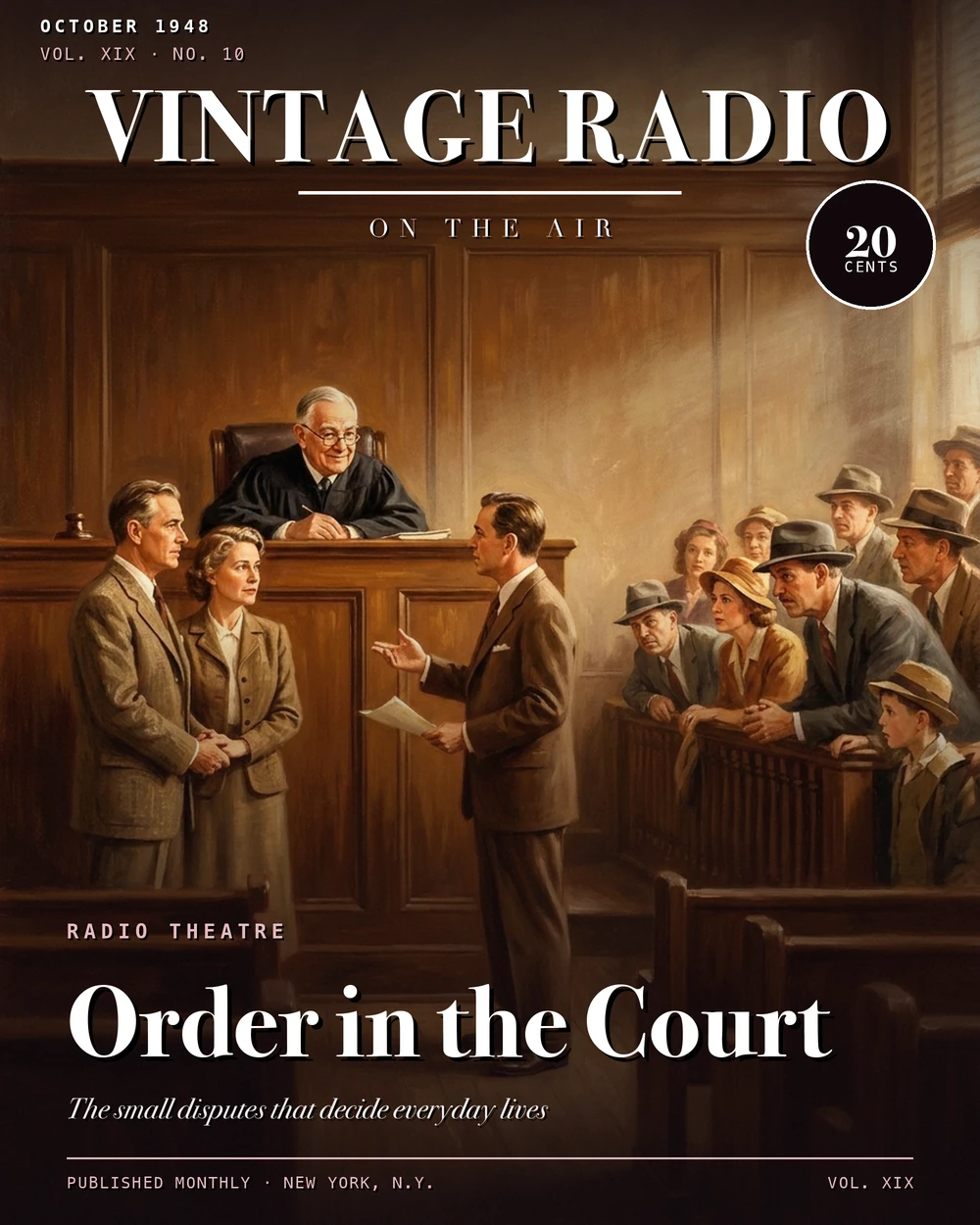
Order in the Court
A Courtroom Drama Built Around Everyday Tragedy
What made Order in the Court distinctive wasn't crime in the usual radio sense — no shootouts, no private eyes, no murder investigations unfolding in rain-soaked alleys. The show planted itself squarely inside a courtroom and stayed there, building its drama out of the kinds of legal trouble that could happen to anyone: a young woman marrying a much older man, a mother-in-law who won't stay out of her son's marriage, a husband found dead under ambiguous circumstances. These were the cases that filled the docket. The show premiered on February 5, 1953, and ran through March 26, 1953 — a tight syndicated run of ten episodes, all of them apparently surviving.
The series was produced and distributed by Charles Michelson Inc., known in the industry as CMI, one of the significant transcription syndicators of the era. CMI's catalog read like a list of the most recognized names in old-time radio — The Shadow, The Green Hornet, Gangbusters, Dragnet — and by 1952 roughly 450 to 500 stations carried CMI-distributed programs, with sponsors including Wrigley's, General Motors, and General Foods. Order in the Court arrived at the tail end of that run, a short-form offering aimed at the daytime audience rather than the prime-time thriller crowd.
The Format That Set It Apart
Each episode opened with a nameless courtroom reporter who introduced the case from the courthouse corridor before stepping back and letting the drama take over. That framing device gave the show a slightly journalistic feel — as if the listener were being walked through a case that had just wrapped, rather than dropped cold into proceedings already underway. It was a modest but effective structural choice that kept the exposition natural.
Once inside the courtroom, the show told its stories through testimony and flashbacks narrated from a witness's point of view. Instead of keeping the drama confined entirely to arguments and objections, the flashbacks let the audience hear the events being described. A witness explaining how a marriage went wrong could take the listener back to the moment it started unraveling. The technique gave the show more emotional range than a straightforward legal debate format would have allowed.
The recurring cast included a judge described as wise but stern, and both defense and prosecution attorneys whose arguments carried the weight of whatever social or ethical issue the episode was built around. No particular actor names are attached to these roles in the surviving record, but the structure made clear that these weren't one-off characters — they were the fixed points around which each new case rotated.
Ten Cases, Ten Stories
The complete run as it survives in the catalog gives a clear picture of what the show was doing week to week. The episode titles alone tell you something: Girl Marries Older Man, Grandmother Turns Son From Wife, Husband Found Dead, Case Of Miss Brent, Dan and Myrtle. These aren't detective-story titles. They read more like the headlines you'd find buried in a newspaper's local court coverage — specific, human-scaled, not particularly glamorous.
The storylines ran toward domestic disputes and family tragedies: a woman accused of an improper relationship with her wealthy employer, interference between spouses from outside the marriage, romantic entanglements with legal consequences. The show was explicitly targeted at a daytime audience, which shaped the kinds of stories it chose. The legal dilemmas were real enough to carry dramatic weight, but they weren't designed to thrill — they were designed to draw in listeners who recognized the situations, or at least knew someone who might have lived through something similar. The aim was to make the legal system feel accessible rather than remote.
Each episode resolved with the rule of law settling the case, which gave the format a consistent moral architecture without requiring the show to preach. The courtroom structure handled that work on its own: someone argued one side, someone argued the other, and the judge brought it to a close.
Where It Fit in 1953
By 1953, courtroom drama had established itself as a recognizable radio format. Order in the Court arrived alongside shows like Famous Jury Trials and You Are The Jury, all of them working the same territory — the idea that a legal proceeding could generate genuine suspense through argument and testimony rather than action. The difference between Order in the Court and the crime-adjacent end of that spectrum was emphasis: where other shows leaned into criminal cases and their lurid details, this one stayed with the civil and domestic, the cases that turned on character and circumstance rather than wrongdoing.
Sound effects and voice acting carried the production weight, as they did on nearly every radio drama of the period. The show used dialogue and narration in balance — courtroom scenes driven by the back-and-forth of examination and cross-examination, with the flashback sequences leaning on atmospheric detail and narration to fill in the scenes being described. That combination kept the pacing from going flat during the stretches where legal argument alone might have slowed things down.
The morality running through the episodes wasn't abstract. Attorneys' arguments reflected the social pressures of the early 1950s — the expectations around marriage, family dynamics, the roles of men and women in domestic life. The cases weren't chosen at random; they were chosen because they touched questions people were actually arguing about at the time, even if the arguments were happening at kitchen tables rather than in courtrooms.
The Record It Left Behind
Ten episodes at roughly four hours and twenty-six minutes of total runtime — that's the entirety of what Order in the Court produced, and apparently all of it survived. For a syndicated show from 1953, that's a reasonably complete picture. Radio Spirits acquired Charles Michelson Inc.'s masters and licenses in 1997, which brought the recordings into a major commercial archive and established a formal chain of preservation for the series.
The show occupies a specific and somewhat narrow slice of old-time radio history: a daytime courtroom drama with a social conscience, built for syndication, running a single season of ten self-contained cases. It wasn't trying to be Dragnet or The Shadow — its CMI stablemates at the more dramatic end of the catalog. It was working a quieter vein, using the courtroom as a place to dramatize the kinds of human complications that don't make for sensational headlines but do make for radio that holds a listener's attention for half an hour. The full ten-episode run survives to make that case on its own terms.